Shiro Tsujimura – The Beauty and Purity of the Earth
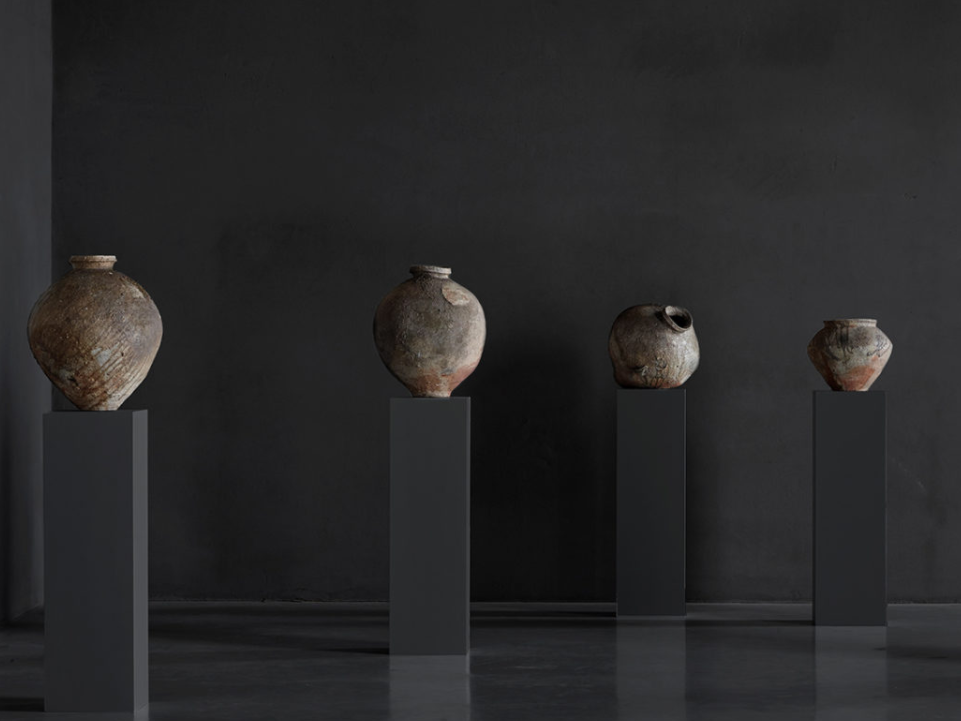
Tsujimura’s art finds its basis upon the beauty and purity of the earth, and its relationship and transformation with nature and fire. He uses local earth from the landscape surrounding his home to create clay. He moulds it and fires it in a wood-burning kiln, which results in the dramatic rivulets of natural ash glaze that decorate its surface. In the kiln, a new, uncontrollable action occurs — some are rendered perfectly, while other works fall apart and start to mingle with nearby pots or bowls resulting in an asymmetrical, seemingly imperfect shape.
After the firing, Tsujimura allows the creations to mature over time in his wild garden. Several of the works selected for the presentation were created in the ‘90s and allowed to rest and become of age. These will be shown in public for the first time. Cracks and what some might perceive as flaws are inherently the opposite: they are a product of nature and time, a purely unique creation that has occurred beyond the will of the human being.
The calligraphies included in the exhibition bear poetic names that are likewise linked to the ephemerality of nature. These include “Spirit”, “Mountain”, “Flowers”, “Truth”, “Snow” and “Earth”. The works were created in 2013 during a live performance on the Kanaal site.
Shiro Tsujimura is one of the most prominent contemporary ceramic artists and has achieved legendary notoriety in his native Japan. Somewhat of an anomaly among Japanese ceramicists, his self-taught practice defies conventional modes of expression in his genre. Although his creations rely on historic techniques found in traditional Japanese and Korean styles, an independent streak characterises his practice above all else. This balance between history and a keen break with formality is what makes his work simultaneously universal, timeless, traditional, and contemporary.
To truly understand Japanese pottery, especially the art of crafting bowls or vases, one must appreciate their inherent spirit. The seeming simplicity contains depth and intelligence. A bowl or a vase is like a container of the void and frames the emptiness. This aspect of emptiness is known as “Ma” in Japanese.
Another important aspect of Japanese ceramics is the beauty of asymmetry and imperfection. Cracks and flaws are a product of nature and time beyond the will of the human being. In 16th century Japan, the celebrated Japanese tea masters such as Sen Rikyu valued the beauty found in imperfect and irregular objects often in their most austere natural state. This led to the unassuming aesthetic ideals of Wabi-cha: simplicity, purity, restraint, and humility. This is what Tsujimura’s art is all about: it is simply Being.
Tsujimura’s art is based on spontaneity and dynamism. Yet, the force of earth and fire, the passion for finding the life of clay in the process of the kiln, expresses a timeless monumentality. He fires Shigaraki, Iga, Shino, Kohiki, Ido, Oku-Korai, Kuro Oribe, and Setoguro all with the same intensity and finesse. Due to the various ways that Tsujimura cools the bowls, some are jet-black while others have shades of rust, chocolate, and even white.
All Images: courtesy of the artist and Axel Vervoordt Gallery.
Shiro Tsujimura Axel Vervoordt Gallery Antwerp, Belgium Through 07 May 2022 https://www.axel-vervoordt.com/
READ MORE FROM ART & PHOTOGRAPHY
“DARKNESS VISIBLE” – A PHOTOGRAPHIC STUDY BY MANI NEJAD Darkness Visible is a visual journey through urban landscapes portraying their structural and formal qualities. Conceived as a black and white study it presents a narrative of fictional minimalism that is drawn from real places in present time…
“THE SWIRL” – PAINTINGS & DRAWINGS OF MANI NEJAD Berlin and London based artist Mani Nejad has been developing his Brain Blitz series over a period of several years. It’s a comprehensive suite of delicate works weaving together various media …
JANAINA TSCHÄPE AT MAX HETZLER GALLERY BERLIN Richly painted using large scale oil sticks in addition to the water-based pigments she previously employed, it marks a fresh direction in Tschäpe’s oeuvre. This material shift allows the artist to “draw” as one would with a pencil or pastel,…