SARAH MORRIS “MACHINES DO NOT MAKE US INTO MACHINES”
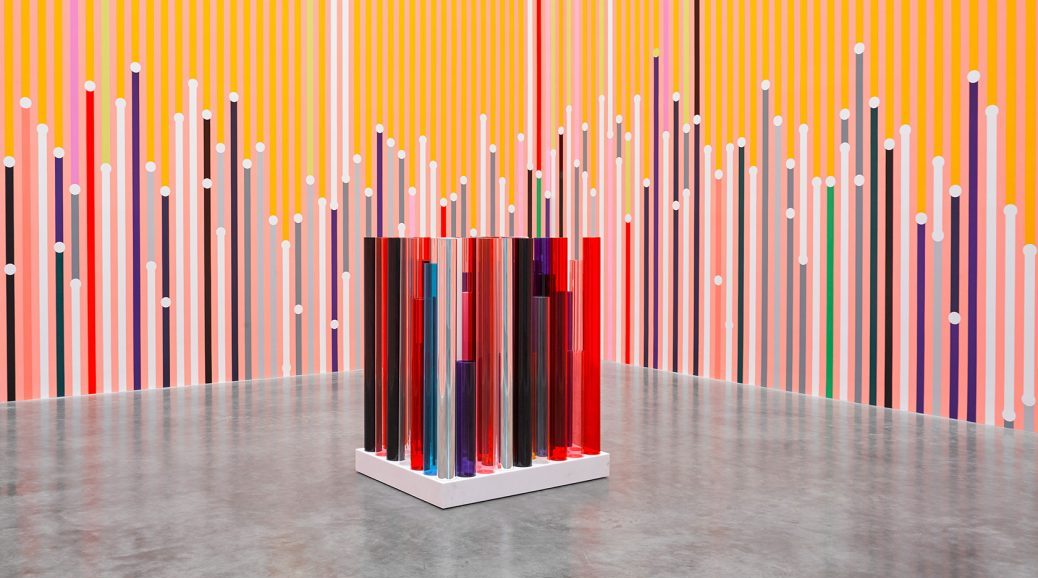
Featuring paintings, films, a site-specific wall painting as well as the artist’s first sculptural work, “Machines do not make us into machines” reflects Morris’s interest in networks, typologies, architecture, language and the city.
Employing an architecture of colourful and abstract forms, Morris’s paintings play on the viewer’s sense of visual recognition. She incorporates a wide range of references, from the graphic identity of multinational corporations and the structure of urban transport systems to the iconography of maps, GPS technology, as well as the movement of people within urban areas. Morris sees her paintings as being part of a larger self-generating system, always remaining open and allowing for interpretation, motion and change.
Within her practice, each canvas and each film can be considered as part of an index, offering a set of coordinates which point to a vast and constantly evolving network of visual, social and political connections.
Morris has said ‘I start the films with coordinates and it is not dissimilar with the paintings. There is a certain set of points, a certain set of coordinates: the places, situations, and rooms I want to be in, and the people I want to meet. It is literally that specific. It’s creating an open system and letting it run.’
Her new series of ‘Sound Graph’ paintings continue to utilize the language of American abstraction, of minimalism and pop, while their forms are derived from the artist’s sound files, using the speech from audio recordings as a starting point for the compositions.
The paintings began when Morris conceptualised the film Finite and Infinite Games (2017), which is also presented in the exhibition. Titled after the cult novel by James P. Carse, the film was shot in Herzog & de Meuron’s infamous and expensive Elbphilharmonie concert hall in Hamburg.
It uses the voice of polymath Alexander Kluge, a German filmmaker, writer, poet, lawyer, philosopher and broadcaster, reading a script Morris crafted from the book, which, according to the artist, functions as a warning. Featuring hard-edged geometric shapes, the compositions in the paintings progress and recede in patterns that appear to fluctuate across the canvas, creating a sense of volumetric build-up and release, as if as a visual analogy of coding.
While they are derived from fragments of conversations, Morris’s forms also reference concrete elements: digital files, the lights on audio equipment, the encoded information on bar charts and flow diagrams or the structures of mapping. Highlighting how language is a construct, particularly important in relation to art in our ‘post-truth’ age, they connect with the history of modernist abstraction while remaining conceptual in their process of production. Here language becomes image, attesting to the impossibility of a painting ever truly being abstract.
Also presented for the first time is a new, large-scale site-specific wall painting titled after Ataraxia (2019), a philosophical concept meaning an end state of ‘imperturbable calm’ or, conversely, a means to an end; the ideal mental state for soldiers preparing for battle. For Morris the state of ataraxia is an impossibility, yet perhaps something that the paintings offer.
The work references the visual iconography of the urban environment, allowing the viewer to reflect on the relationships between the space of the gallery, the surrounding city, the abstract space of the work, and speech and vision itself. Like her paintings on canvas, Morris’s wall painting maintains an endless series of global connections, using the grid as a constantly expanding form beyond the viewer’s immediate field of vision.
READ MORE FROM ART & PHOTOGRAPHY
“THE SWIRL” – PAINTINGS & DRAWINGS OF MANI NEJAD
Berlin and London based artist Mani Nejad has been developing his Brain Blitz series over a period of several years. It’s a comprehensive suite of delicate works weaving together various media …
Qi Lei – Echoes of Day and Night
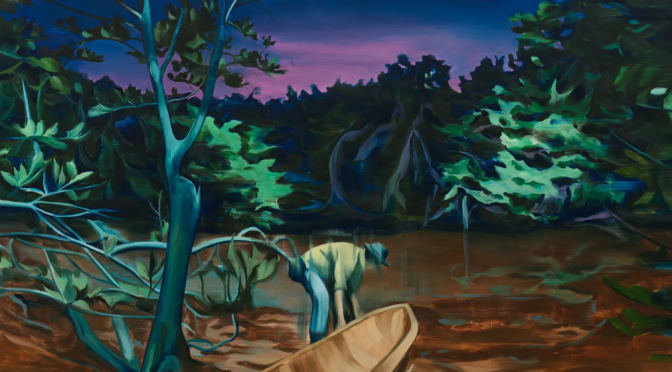
Echoes of Day and Night is a solo presentation by Chinese artist Qi Lei at Ben Brown Fine Arts in Hongkong. The exhibition centres on the artist’s recent reflections on music, painting and time with the title emerging from the…
ANGEL OTERO – MAGICAL REALISM AND ABSTRACTION
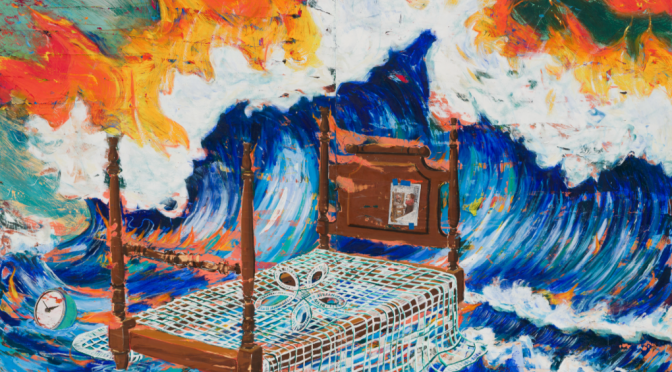
Over the last decade, New York-based artist Angel Otero has experimented with numerous genres and styles, from early still lifes, domestic interiors, and landscapes, to pure abstraction created using his innovative oil paint …