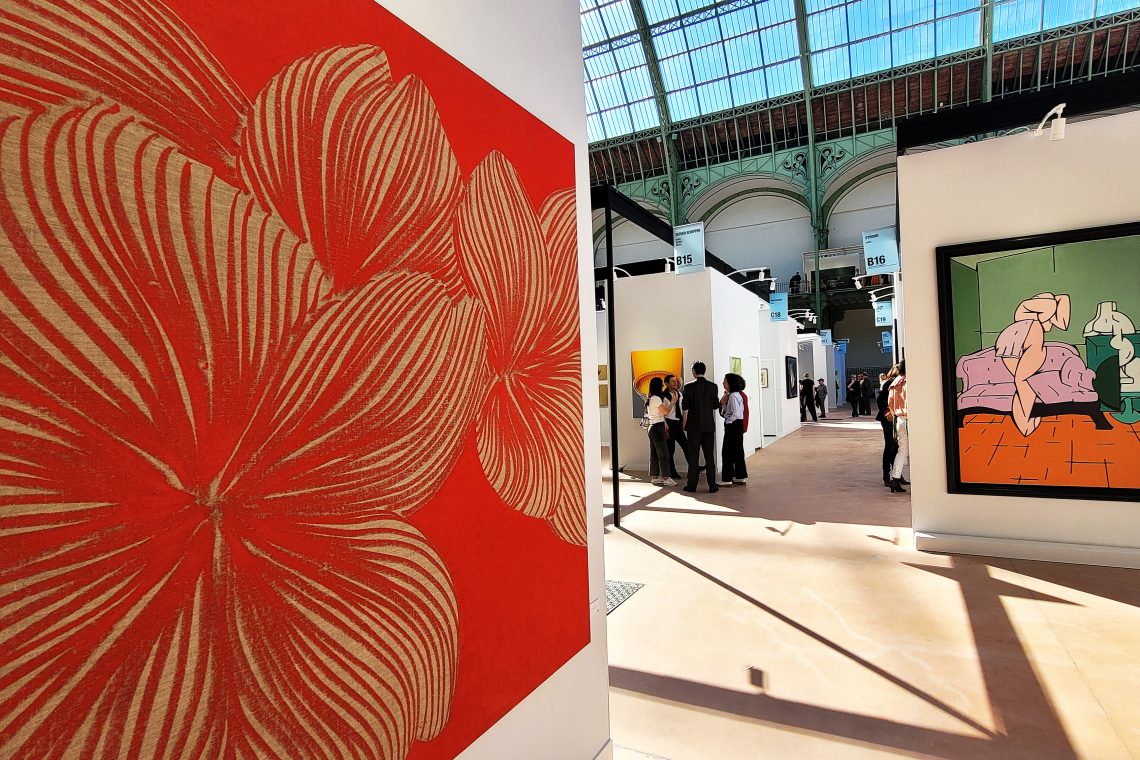
Don’t miss this event: Art Paris returns to the newly restored Grand Palais, reaffirming its role as the leading spring rendezvous for modern and contemporary art in the French capital. Now in its 28th edition, the fair unfolds from April 9 to 12 beneath the iconic glass nave, bringing together approximately 165 galleries from around 25 countries.
What distinguishes Art Paris from the global circuit of mega-fairs is its deliberate positioning – it’s both regional and international. While maintaining a strong commitment to the French art scene, the fair increasingly situates this local perspective within a broader, global dialogue.
The 2026 edition continues this trajectory, presenting a diverse range of practices—from established modern masters to emerging contemporary voices—through a carefully curated gallery selection. Galleries act as mediators, shaping a layered ecosystem of representation that reflects both market dynamics and curatorial vision.
Central to the 2026 edition are two thematic strands: “Babel: Art and Language in France” and “Reparation.” These curatorial frameworks foreground questions of communication, identity, memory, and historical responsibility. “Babel” explores the multiplicity of voices within the French artistic landscape, emphasizing linguistic diversity as both a conceptual and political tool. Participating galleries—such as Galerie Lelong, Almine Rech, and Galerie Nathalie Obadia—anchor the section with artists whose practices interrogate translation, hybridity, and cultural circulation.
“Reparation,” by contrast, addresses the ethics of restitution and the afterlives of colonial histories. In doing so, the fair aligns itself with broader institutional debates currently shaping museums and collections worldwide.
Beyond its thematic exhibitions, Art Paris continues to invest in younger galleries through sectors such as “Promises.” This section provides visibility to emerging artists and experimental practices, reinforcing the fair’s reputation as a site of discovery rather than mere consolidation.
Additionally, the Solo Show program—comprising around 24 monographic presentations—offers focused insights into individual artistic practices, allowing for deeper engagement within the otherwise dense fair environment.
In recent years, Art Paris has expanded beyond traditional fine art to include design and cross-disciplinary practices. The French Design Art Edition platform showcases limited-edition design pieces and collectible furniture, blurring the boundaries between art, craft, and design. Equally significant is the fair’s commitment to sustainability. Its eco-design approach—favoring local sourcing, reduced transport, and digital tools such as virtual visits—signals a growing awareness of the environmental impact of large-scale art events.
Art Paris 2026 resists the homogenization often associated with global art fairs. Instead, it proposes a more nuanced model—one that privileges curatorial framing, supports emerging talent, and fosters critical discourse. At a moment when the art market is increasingly polarized between blockbuster events and local initiatives, Art Paris occupies a compelling middle ground. It is a fair that does not merely reflect the art world but actively contributes to shaping its evolving geography—anchored in Paris, yet attentive to the multiplicity of voices that define contemporary art today.
ART PARIS 2026 9 through 12 April 2026 GRAND PALAIS PARIS, FRANCE www.artparis.com
.
.
READ MORE FROM ART & PHOTOGRAPHY
Michael Armitage “The Promise of Change” at the Pinault Collection Venice In 2026 the Pinault Collection will present ‘The Promise of Change’, a solo exhibition by Michael Armitage at Palazzo Grassi, Venice, showcasing a comprehensive overview of the artist’s practice. Bringing together a selection of works created over the past 10…
“THE SWIRL” – PAINTINGS & DRAWINGS OF MANI NEJAD Berlin and London based artist Mani Nejad has been developing his Brain Blitz series over a period of several years. It’s a comprehensive suite of delicate works weaving together various media …
“DARKNESS VISIBLE” – A PHOTOGRAPHIC STUDY BY MANI NEJAD Darkness Visible is a visual journey through urban landscapes portraying their structural and formal qualities. Conceived as a black and white study it presents a narrative of fictional minimalism that is drawn from real places in present time…