SCALE, COLOR & VOLUME – SCULPTURES BY ANISH KAPOOR
Anish Kapoor is one of the most influential sculptors of his generation. Perhaps most famous for public sculptures that are both adventures in form and feats of engineering, Kapoor manoeuvres between vastly different scales, across numerous series of work.
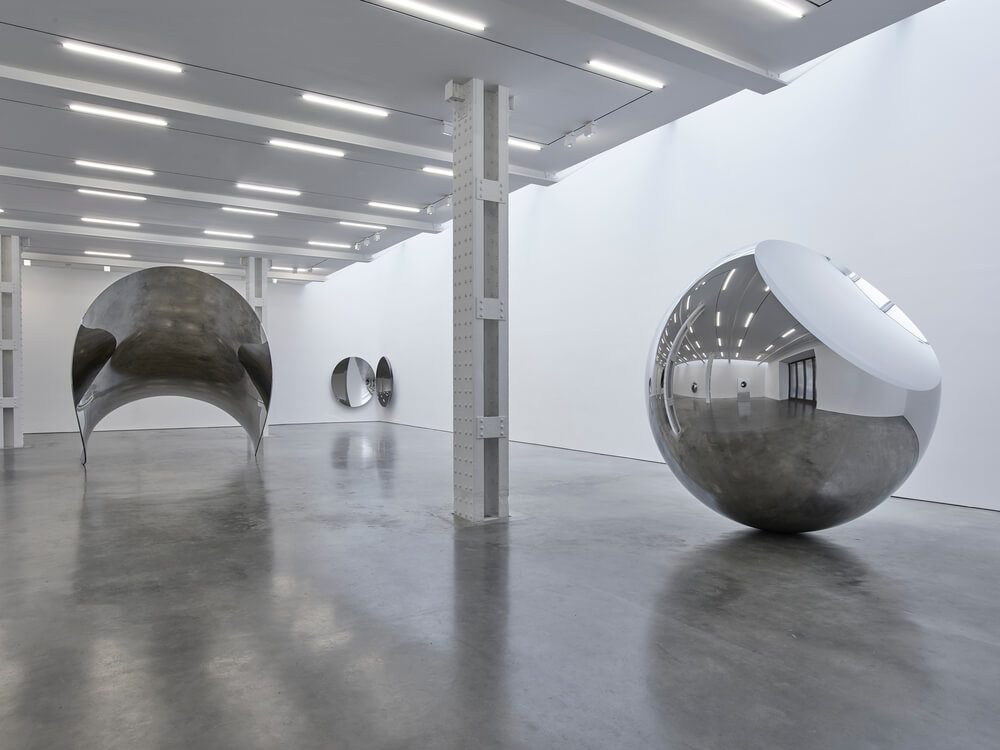
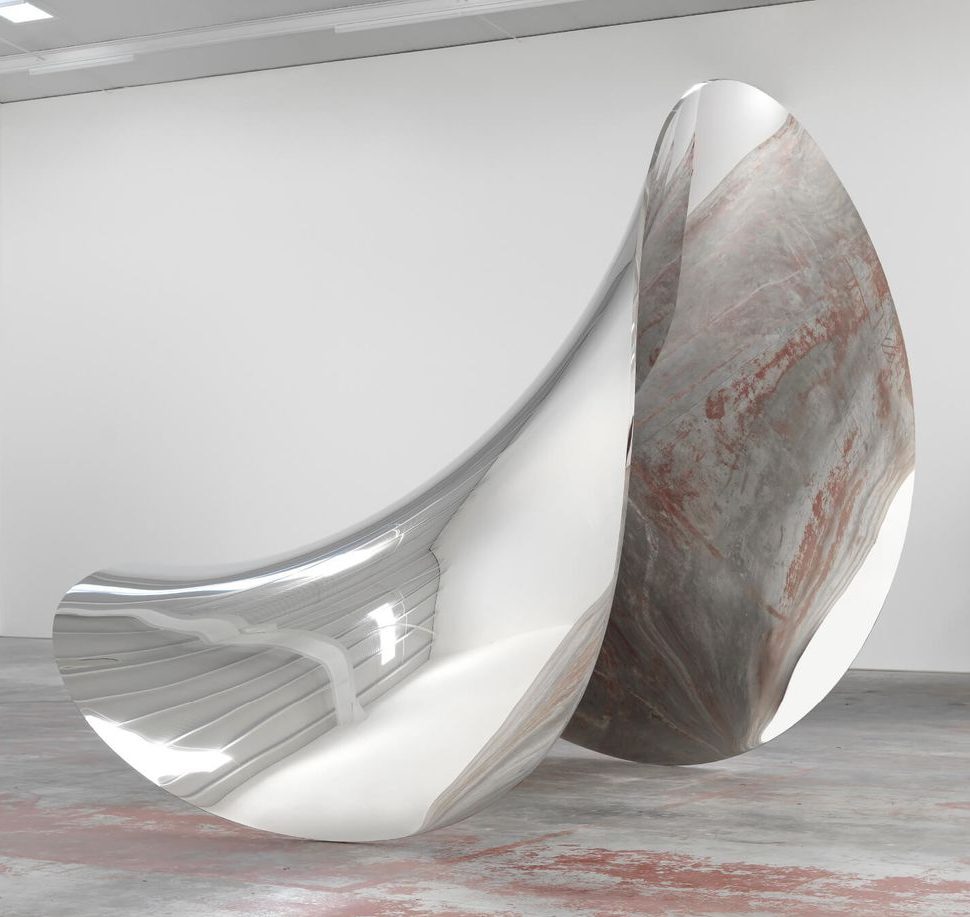
Immense PVC skins, stretched or deflated; concave or convex mirrors whose reflections attract and swallow the viewer; recesses carved in stone and pigmented so as to disappear: these voids and protrusions summon up deep-felt metaphysical polarities of presence and absence, concealment and revelation.
Forms turn themselves inside out, womb-like, and materials are not painted but impregnated with colour, as if to negate the idea of an outer surface, inviting the viewer to the inner reaches of the imagination.
Kapoor’s geometric forms from the early 1980s, for example, rise up from the floor and appear to be made of pure pigment, while the viscous, blood-red wax sculptures from the last ten years – kinetic and self-generating – ravage their own surfaces and explode the quiet of its environment.
I think I understand something about space. I think the job of a sculptor is spacial as much as it is to do with form.
~ Anish Kapoor ~
Kapoor redefined contemporary sculpture in the 1980s through innovative approaches to scale, color, volume and materiality, and by delving into the illusory. Perhaps most famous for public sculptures that are both adventures in form and feats of engineering, Kapoor’s works invite viewers to interrogate their relation to inhabited space.
Kapoor confronts our expectation of optical perception, forcing a re-examination of one’s phenomenological experience.
One of the defining languages of this artist’s oeuvre is indisputably his manipulation of space, and the mirrored surface as a material in this endeavor can be seen internationally through his major public commissions.
Kapoor invites the viewer to not simply look at the object, but through and beyond it, invoking both terror and beauty, and questioning absence and presence in the face of the force of nature.
There are resonances with mythologies of the ancient world – Indian, Egyptian, Greek and Roman – and with modern times.
Since the Romantic conception of the sublime, artists such as Caspar David Friedrich have expressed the sensation of wonder evoked by the natural landscape. Unlike Friedrich, Kapoor’s stainless steel works gaze back at you, existentially reflecting the self.
Anish Kapoor was born in 1954 in Mumbai, and lives and works in London. His work is featured in public collections including Museum of Modern Art, New York; Hara Museum of Contemporary Art, Tokyo; Hirshhorn Museum and Sculpture Garden, Washington, D.C.; Moderna Museet, Stockholm; Museo National Centro de Arte Reina Sofia, Madrid; San Francisco Museum of Modern Art; Stedelijk Museum, Amsterdam; Tate Modern, London; Tate Britain; Tel Aviv Museum of Art; and Walker Art Center, Minneapolis.
JANAINA TSCHÄPE AT MAX HETZLER GALLERY BERLIN Richly painted using large scale oil sticks in addition to the water-based pigments she previously employed, it marks a fresh direction in Tschäpe’s oeuvre. This material shift allows the artist to “draw” as one would with a pencil or pastel,…
DAVID HOCKNEY AT ANNELY JUDA GALLERY LONDON Following David Hockney’s celebrated exhibition at Fondation Louis Vuitton in Paris last summer, this show debuts never-seen-before paintings completed in the artist’s London studio over the last six months, underpinning Hockney’s unwavering commitment to and vigour for the act of…
LEE BAE “THE IN-BETWEEN” AT PERROTIN GALLERY TOKYO Korean artist Lee Bae, based in Paris and Cheongdo, has gained international recognition for is extraordinary aesthetic and material experiments with charcoal – comprising various media …